A little shout out for the Vancouver boys because I love this video !
Come on, why not buy it, you get a free set of Kitchen Knives !!
Showing posts with label SharePoint 2010. Show all posts
Showing posts with label SharePoint 2010. Show all posts
Wednesday, 29 September 2010


Tuesday, 22 June 2010
SharePoint, Intranets and webinars, oh my......
Apologies for taking so long to write about this, but last Thursday (18th of June) I took part in an Intranet Benchmarking Forum webinar as a panelist.
The webinar was an "open to the public" event of the IBF SharePoint Special Interest Group (SIG) and it was timed to coincide with the release of a new IBF report on SharePoint 2010. The report was written by my good colleague Martin White of Intranet Focus Ltd, and myself and the other panelists, Michael Sampson and Richard Harbridge and varying degrees of input. It's an excellent report (IMHO) and you can purchase a copy from the IBF.
Michael posted his thoughts about the event on his blog much more promptly, finishing his article with this statement: "Don't get pushed into doing unnatural acts with SharePoint because Microsoft or your Business Partner thinks you should. It will take time ... and money ... and thought. Spend it now, or spend it repeatedly over the next few years."
Truly excellent advice that I agree with wholeheartedly ! However I want to return to a question which Martin does address in the report, but which was also asked by attendee's:
Where does SharePoint 2010 fit with my intranet ?
Well its a good question, but unfortunately there is no one size fits all standard answer (oh come on now, there never is !). The question has to be examined in context, and reflected upon by asking follow up questions about your current intranet, and what your aspirations for further development of your intranet are.
For a start, what is your organisations definition of 'intranet' ? I have tackled that question before in this posting: What is an intranet anyway?
There are various intranet maturity frameworks available, but this is a good one based on original Avenue A | Razorfish work from some years ago: The Intranet Maturity Framework - so where does your current intranet sit with respect to this framework ? And perhaps more to the point, where do you want to be ?
I ask this question because its a good way of mapping your requirements to SharePoint 2010 feature sets. So for example if your a:
This is what I mean by "it depends on your context" ! So we are back to what do you define as the intranet, and what do you want to do with it ? (See this excellent presentation on SlideShare by James Robertson of Step 2 Designs "The four purposes of an intranet" for some ideas!).
As I have said many times before on this blog, start with your requirements - this links to Michael's closing comment which I quoted above, don't let IT push you into using SharePoint 'Sites' WCM for your 'corporate intranet' layer just because SharePoint has been procured to fulfill the collaboration requirements, or the dashboard-ing requirements. One size does not fit all, and shoe horn-ing parts of your intranet into SharePoint "because we have it" is no recipe for success.
However to be pragmatic, SharePoint might meet 75% to 80% of your requirements, in other words it may be "good enough" even if its not perfect. You may find an integration with an existing WCMS, or a third party add on takes you up to the 90% to 100% mark !
So to summarize - "how does SharePoint fit with / fit into my intranet" - I don't know, nobody does actually. It's up to you to do your requirements analysis and then decide upon the fit based on research or the help of vendor neutral consultants.
The webinar was an "open to the public" event of the IBF SharePoint Special Interest Group (SIG) and it was timed to coincide with the release of a new IBF report on SharePoint 2010. The report was written by my good colleague Martin White of Intranet Focus Ltd, and myself and the other panelists, Michael Sampson and Richard Harbridge and varying degrees of input. It's an excellent report (IMHO) and you can purchase a copy from the IBF.
Michael posted his thoughts about the event on his blog much more promptly, finishing his article with this statement: "Don't get pushed into doing unnatural acts with SharePoint because Microsoft or your Business Partner thinks you should. It will take time ... and money ... and thought. Spend it now, or spend it repeatedly over the next few years."
Truly excellent advice that I agree with wholeheartedly ! However I want to return to a question which Martin does address in the report, but which was also asked by attendee's:
Where does SharePoint 2010 fit with my intranet ?
Well its a good question, but unfortunately there is no one size fits all standard answer (oh come on now, there never is !). The question has to be examined in context, and reflected upon by asking follow up questions about your current intranet, and what your aspirations for further development of your intranet are.
For a start, what is your organisations definition of 'intranet' ? I have tackled that question before in this posting: What is an intranet anyway?
There are various intranet maturity frameworks available, but this is a good one based on original Avenue A | Razorfish work from some years ago: The Intranet Maturity Framework - so where does your current intranet sit with respect to this framework ? And perhaps more to the point, where do you want to be ?
I ask this question because its a good way of mapping your requirements to SharePoint 2010 feature sets. So for example if your a:
- Stage 1 Communications & Information sharing intranet - then you probably need to be interested in SharePoints Sites features (the Web Content Management or "Publishing" features)
- Stage 3 Collaboration driven intranet - then your focus maybe on the 'communities' features, i.e. Team Sites and other collaboration features
- Stage 5 Digital Dashboards - if your at this stage then its all about the 'insights' features for you, maybe with a dash of 'composites' added too
This is what I mean by "it depends on your context" ! So we are back to what do you define as the intranet, and what do you want to do with it ? (See this excellent presentation on SlideShare by James Robertson of Step 2 Designs "The four purposes of an intranet" for some ideas!).
As I have said many times before on this blog, start with your requirements - this links to Michael's closing comment which I quoted above, don't let IT push you into using SharePoint 'Sites' WCM for your 'corporate intranet' layer just because SharePoint has been procured to fulfill the collaboration requirements, or the dashboard-ing requirements. One size does not fit all, and shoe horn-ing parts of your intranet into SharePoint "because we have it" is no recipe for success.
However to be pragmatic, SharePoint might meet 75% to 80% of your requirements, in other words it may be "good enough" even if its not perfect. You may find an integration with an existing WCMS, or a third party add on takes you up to the 90% to 100% mark !
So to summarize - "how does SharePoint fit with / fit into my intranet" - I don't know, nobody does actually. It's up to you to do your requirements analysis and then decide upon the fit based on research or the help of vendor neutral consultants.
Friday, 23 April 2010
More SharePoint 2010 seminars and learning
It's been a busy couple of days ! Yesterday morning the Toronto AIIM Chapter held a MS sponsored event on the 'future of productivity' - mainly Office 2010 and SharePoint 2010. This morning was a longer session held by EnvisionIT at the Microsoft Canada offices in Mississauga. Strangely enough it was EnvisionIT who brought two early adopter SP2010 clients to the AIIM seminar as case studies too !
The opening part of the AIIM session was presented by Sam Fung and Savash Alic from Microsoft. It was a very high level overview of what's coming in the near to mid term. I have to say I was slightly disturbed by Savash' constant references to 'ease of use' for end users, how they could build this and build that. We all know how easy it is to build SharePoint sites, and it one organization I had as a consulting client, the resulting chaos of over 1,400 teams sites and portal sites was a vivid example of why unmanaged / ungoverned 'ease of use' can be a bad thing !
Anyway, new things that I had not seen before including the LookingGlass project, which appears to be social media analytics served up to the user via a customised SharePoint portal. There is also a data visualization tool from Live Labs called Pivot - you can check it out at www.getpivot.com.
There was also mention of an Office Labs project called SISR - Social Inranet Search Ranking, but it does not seem to be mentioned on the Labs site at the moment. Basically it appears to be an enhancement to the SharePoint intranet search engines ranking algorithms to include social ranking (an OOB feature in SP2010).
Today at the EnvisionIT seminar it was the turn of ECM or the 'content' slice of the SP2010 'pie chart'. You can check out the Content section of the SharePoint 2010 site to see what Microsoft includes under this heading.
Interestingly the AIIM definition of ECM was used to set the scene, but if you have ever read this blog or my articles elsewhere, you will know that I do not consider MOSS2007 as an 'ECM platform' in any shape or form ! As far as I am concerned MOSS2007 is a Portal platform (similar to IBM WebSphere for example) with built in simple content, document management and collaboration features (and for developers it is of course a .Net development platform). It is simply missing too much functionality compared to EMC Documentum or OpenText ECM Suite (ex-LiveLink) for example, to be considered an ECM platform. Which is why the term 'Basic Content Services' was coined by Gartner to describe SharePoint (and other similarly limited products).
Which of course does not mean that MOSS2007 has not been a successful product ! It has it's niches in divisional level portals, collaboration workspaces (Team sites) and document centric collaboration. But as I work with it day in and day out, I find I am constantly frustrated by its limitations. Often those limitations can be overcome with a large dolop of cash for a third party add on, or custom development work, but in my organization (as in many I suspect) - "out of the box" is the current mantra.
So, what does SP2010 bring to the party ? Is it truly an ECM platform on a level playing field with the 'big boys' now ? Well, no, not in my opinion, but its got a lot of features that were required, and so its much better than it was - and therefore it might well be 'good enough' to meet your requirements.
New OOB Content Types for rich media have been added. So instead of the old 'picture library' you can now have a 'Digital Assets' library, but from what I have seen the Content Types do not as standard have the fields required by any of the industry standard digital asset metadata schemas (such as XMP), so I am guessing uploading an asset does not including removing any metadata from the file and auto-populating the SharePoint 'columns' with it. However, as I noted this is an improvement over MOSS, and elements such as being able to stream video from within the library (via built in SilverLight) will go over well in many intranet scenarios I suspect.
The new Unique Identifier feature, pretty much does what it says on the tin. Set up at the site collection level, you can provide some characters yourself for the beginning of the ID string, and then SP2010 will give each new content item its unique ID, which also happens to be a persistent URI, or 'permalink' able to point to the document wherever you move it within the SharePoint site.
Metadata management is much improved (thank goodness !). The new Managed Metadata Service allows structured hierarchical taxonomies to be created and shared across site collections. This CMS Wire article: "Overview: SharePoint 2010 Metadata and Taxonomy Management" by Stephanie Lemieux of Early and Associates, is an excellent introduction, so I don't need to repeat its content here. However as well as the 'managed' metadata features described by Stephanie, SP2010 allows 'user tagging' or a Folksonomy approach to metadata to be used as well. Finally, it provides a bridge between the two, allowing often used tags to be added to the official taxonomy. So, all of this is good, and much better than what was previously available, but even better in my opinion is the ability to set metadata at the folder level and have any content item uploaded into the folder inherit that metadata. Why is this such a good thing you ask ? Well because even though we information management professionals understand the importance of metadata, your average end user just see's it as an extra impediment to actually getting their work done. So if you can set it up so that as much metadata as possible can be inherited without human intervention - that is a good thing !
Records Management is also much improved, with possibly the biggest change being the 'manage in place' facility, which means you no longer have to send the potential record to a separate Records Centre (but you still can if you want to). Interesting on this front, at the AIIM seminar I bumped into a contact who used to be an RM specialist for the big Canadian consulting firm CGI. Tim has got together with some colleagues to create a start-up called OceanRoad Software, and they are developing a product which further extends the RM functionality of SharePoint. I wish them a lot of luck in their new venture.
In summary, SP2010 is still missing a lot of features of the big ECM suites. That might be countered with the argument that it is simpler to deploy and use, but I don't think that is always true either. However I am not actually intending this to sound like a negative review. I have a SP2010 demo disk, but I don't have enough memory on my iMac to install it on a Windows 7 VM, so it will be a while before I get to thoroughly kick the tires, and get under the hood. Meanwhile, my bottom line is what it has always been for MOSS2007 - don't blindly believe the SP2010 hype, sort out your requirements first, then talk to MS or its partners, and see if SP2010 will be a good fit for your requirements - you will either be slightly disappointed, or pleasantly surprised :-)
The opening part of the AIIM session was presented by Sam Fung and Savash Alic from Microsoft. It was a very high level overview of what's coming in the near to mid term. I have to say I was slightly disturbed by Savash' constant references to 'ease of use' for end users, how they could build this and build that. We all know how easy it is to build SharePoint sites, and it one organization I had as a consulting client, the resulting chaos of over 1,400 teams sites and portal sites was a vivid example of why unmanaged / ungoverned 'ease of use' can be a bad thing !
Anyway, new things that I had not seen before including the LookingGlass project, which appears to be social media analytics served up to the user via a customised SharePoint portal. There is also a data visualization tool from Live Labs called Pivot - you can check it out at www.getpivot.com.
There was also mention of an Office Labs project called SISR - Social Inranet Search Ranking, but it does not seem to be mentioned on the Labs site at the moment. Basically it appears to be an enhancement to the SharePoint intranet search engines ranking algorithms to include social ranking (an OOB feature in SP2010).
Today at the EnvisionIT seminar it was the turn of ECM or the 'content' slice of the SP2010 'pie chart'. You can check out the Content section of the SharePoint 2010 site to see what Microsoft includes under this heading.
Interestingly the AIIM definition of ECM was used to set the scene, but if you have ever read this blog or my articles elsewhere, you will know that I do not consider MOSS2007 as an 'ECM platform' in any shape or form ! As far as I am concerned MOSS2007 is a Portal platform (similar to IBM WebSphere for example) with built in simple content, document management and collaboration features (and for developers it is of course a .Net development platform). It is simply missing too much functionality compared to EMC Documentum or OpenText ECM Suite (ex-LiveLink) for example, to be considered an ECM platform. Which is why the term 'Basic Content Services' was coined by Gartner to describe SharePoint (and other similarly limited products).
Which of course does not mean that MOSS2007 has not been a successful product ! It has it's niches in divisional level portals, collaboration workspaces (Team sites) and document centric collaboration. But as I work with it day in and day out, I find I am constantly frustrated by its limitations. Often those limitations can be overcome with a large dolop of cash for a third party add on, or custom development work, but in my organization (as in many I suspect) - "out of the box" is the current mantra.
So, what does SP2010 bring to the party ? Is it truly an ECM platform on a level playing field with the 'big boys' now ? Well, no, not in my opinion, but its got a lot of features that were required, and so its much better than it was - and therefore it might well be 'good enough' to meet your requirements.
New OOB Content Types for rich media have been added. So instead of the old 'picture library' you can now have a 'Digital Assets' library, but from what I have seen the Content Types do not as standard have the fields required by any of the industry standard digital asset metadata schemas (such as XMP), so I am guessing uploading an asset does not including removing any metadata from the file and auto-populating the SharePoint 'columns' with it. However, as I noted this is an improvement over MOSS, and elements such as being able to stream video from within the library (via built in SilverLight) will go over well in many intranet scenarios I suspect.
The new Unique Identifier feature, pretty much does what it says on the tin. Set up at the site collection level, you can provide some characters yourself for the beginning of the ID string, and then SP2010 will give each new content item its unique ID, which also happens to be a persistent URI, or 'permalink' able to point to the document wherever you move it within the SharePoint site.
Metadata management is much improved (thank goodness !). The new Managed Metadata Service allows structured hierarchical taxonomies to be created and shared across site collections. This CMS Wire article: "Overview: SharePoint 2010 Metadata and Taxonomy Management" by Stephanie Lemieux of Early and Associates, is an excellent introduction, so I don't need to repeat its content here. However as well as the 'managed' metadata features described by Stephanie, SP2010 allows 'user tagging' or a Folksonomy approach to metadata to be used as well. Finally, it provides a bridge between the two, allowing often used tags to be added to the official taxonomy. So, all of this is good, and much better than what was previously available, but even better in my opinion is the ability to set metadata at the folder level and have any content item uploaded into the folder inherit that metadata. Why is this such a good thing you ask ? Well because even though we information management professionals understand the importance of metadata, your average end user just see's it as an extra impediment to actually getting their work done. So if you can set it up so that as much metadata as possible can be inherited without human intervention - that is a good thing !
Records Management is also much improved, with possibly the biggest change being the 'manage in place' facility, which means you no longer have to send the potential record to a separate Records Centre (but you still can if you want to). Interesting on this front, at the AIIM seminar I bumped into a contact who used to be an RM specialist for the big Canadian consulting firm CGI. Tim has got together with some colleagues to create a start-up called OceanRoad Software, and they are developing a product which further extends the RM functionality of SharePoint. I wish them a lot of luck in their new venture.
In summary, SP2010 is still missing a lot of features of the big ECM suites. That might be countered with the argument that it is simpler to deploy and use, but I don't think that is always true either. However I am not actually intending this to sound like a negative review. I have a SP2010 demo disk, but I don't have enough memory on my iMac to install it on a Windows 7 VM, so it will be a while before I get to thoroughly kick the tires, and get under the hood. Meanwhile, my bottom line is what it has always been for MOSS2007 - don't blindly believe the SP2010 hype, sort out your requirements first, then talk to MS or its partners, and see if SP2010 will be a good fit for your requirements - you will either be slightly disappointed, or pleasantly surprised :-)
Friday, 26 March 2010
SharePoint 2010 for BI seminar
This morning I attended a seminar put on by EnvisionIT at the Microsoft Canada headquarters in Mississauga.
It was a fascinating session, as I would not say BI was my area of expertise at all ! I did a couple of two day training courses when I was working at the OU, so that I could work with the SAS data warehouse, and we did some development work with the in-house SAS experts in order to build a dashboard type Management Information web site, but that must have been getting on for 6 or 7 years ago now.
Anyway, according to the Wikipedia definition of Business Intelligence, it has a number of common functions including: online analytical processing, analytics, data mining, business performance management, benchmarking, text mining, and predictive analytics.
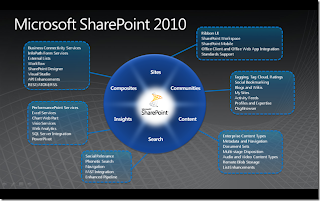
So where does SharePoint come into this? Well in MOSS2007 BI was one of the 'pillars' whereas in SharePoint 2010 it now comes under the heading of 'Insights' in the new pie chart:
So is SP2010 really "BI for the masses" - no way ! No more than MOSS2007 was really "ECM for the masses" - these are just horrible marketing phrases. However will SP2010 with enterprise CAL's and the attendant SQL Server 2008 licenses be able to provide "timely access to business intelligence data" - absolutely ! And it will provide the tools and capabilities to allow you to slice and dice as you require, and to mash it up and present it in easily digestible formats.
Add to that the capability to use the 'Insights' elements with the collaboration tools such as blogs and wiki's and other social computing elements (user tagging and rating) to explain values, trends, the benchmarks your using etc, etc, then SP2010 definately provides the basis for building highly interactive and very usable 'decision support systems'.
A big thanks to Peter Carson, President of EnvisionIT, Joe Seguin Senior Consultant at EnvisionIT and Eric Moll of Microsoft for an excellent briefing.
It was a fascinating session, as I would not say BI was my area of expertise at all ! I did a couple of two day training courses when I was working at the OU, so that I could work with the SAS data warehouse, and we did some development work with the in-house SAS experts in order to build a dashboard type Management Information web site, but that must have been getting on for 6 or 7 years ago now.
Anyway, according to the Wikipedia definition of Business Intelligence, it has a number of common functions including: online analytical processing, analytics, data mining, business performance management, benchmarking, text mining, and predictive analytics.
So where does SharePoint come into this? Well in MOSS2007 BI was one of the 'pillars' whereas in SharePoint 2010 it now comes under the heading of 'Insights' in the new pie chart:

There is a great deal of functionality pulled together into this 'Insights' heading, including:
Well no, not at all actually. SP2010 brings enhanced portal features and enhanced connectivity to other data sources (structured and non-structured) but SharePoint itself, not even with Performance Point Services, is not a business intelligence system, like Cognos for example.
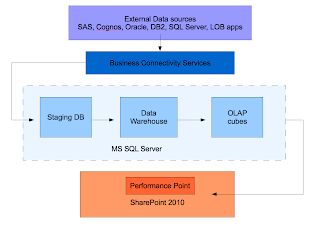
What it is, is a portal with enhanced dashboarding and other elements that provide the "presentation layer" for your BI 'system'. I have attempted to reproduce an architecture slide we were shown, which shows that to pull data in from other sources you need to do an Extract Transform and Load (ETL) operation, so that OLAP cubes can be built using SQL Server's Reporting Services, and this in turn can feed the data to the SharePoint components for rendering and display:
Visio Services adds an interesting element to the mix - it is basically Microsofts's 'mashup' engine - producing interactive graphics using Silverlight, which allow you to graphically interact with data. For example if you have those lovely Visio diagrams of your data centre (or server room) that infrastructure people normally delight in creating - you can use this as graphical element and combine it with data from your monitoring systems so that if a server goes offline, then it goes red and flashes in the picture ! OK, not a very BI centric example, but you get the idea.
Excel and Access Services are there to help provide some centralised management of the data created, stored and manipulated in these tools. I have always thought that Access 'End User Computing' was a bit of nightmare, non-developers using a desktop tool to 'develop' what often turn into business critical LOB apps. Excel can be the same, I have seen businesses where the financial 'system' is 20 highly complex interlinked Excel files... !! So Excel and Access services allow you to draw things back towards the centralised management that allows you be sure what is the 'single source of truth' by publishing the information via SharePoint.
- Performance Point Services
- Access Services
- Excel Services
- Visio Services
- Business Connectivity Services
Well no, not at all actually. SP2010 brings enhanced portal features and enhanced connectivity to other data sources (structured and non-structured) but SharePoint itself, not even with Performance Point Services, is not a business intelligence system, like Cognos for example.
What it is, is a portal with enhanced dashboarding and other elements that provide the "presentation layer" for your BI 'system'. I have attempted to reproduce an architecture slide we were shown, which shows that to pull data in from other sources you need to do an Extract Transform and Load (ETL) operation, so that OLAP cubes can be built using SQL Server's Reporting Services, and this in turn can feed the data to the SharePoint components for rendering and display:

Click on the diagram to see a full sized version
BI for the masses then ? Maybe, but possibly more because of the ability of business power users to use SharePoint designer without recourse to professional developers in order to build their dashboard sites, but that is definitely power user - not 'normal' user. That being said, it does appear easier to do things than my 'back in the day' SAS experience (which is what you would hope after 6 years !) and if you have any experience at all with building 'web part' pages in MOSS2007, you will feel at home.Visio Services adds an interesting element to the mix - it is basically Microsofts's 'mashup' engine - producing interactive graphics using Silverlight, which allow you to graphically interact with data. For example if you have those lovely Visio diagrams of your data centre (or server room) that infrastructure people normally delight in creating - you can use this as graphical element and combine it with data from your monitoring systems so that if a server goes offline, then it goes red and flashes in the picture ! OK, not a very BI centric example, but you get the idea.
Excel and Access Services are there to help provide some centralised management of the data created, stored and manipulated in these tools. I have always thought that Access 'End User Computing' was a bit of nightmare, non-developers using a desktop tool to 'develop' what often turn into business critical LOB apps. Excel can be the same, I have seen businesses where the financial 'system' is 20 highly complex interlinked Excel files... !! So Excel and Access services allow you to draw things back towards the centralised management that allows you be sure what is the 'single source of truth' by publishing the information via SharePoint.
So is SP2010 really "BI for the masses" - no way ! No more than MOSS2007 was really "ECM for the masses" - these are just horrible marketing phrases. However will SP2010 with enterprise CAL's and the attendant SQL Server 2008 licenses be able to provide "timely access to business intelligence data" - absolutely ! And it will provide the tools and capabilities to allow you to slice and dice as you require, and to mash it up and present it in easily digestible formats.
Add to that the capability to use the 'Insights' elements with the collaboration tools such as blogs and wiki's and other social computing elements (user tagging and rating) to explain values, trends, the benchmarks your using etc, etc, then SP2010 definately provides the basis for building highly interactive and very usable 'decision support systems'.
A big thanks to Peter Carson, President of EnvisionIT, Joe Seguin Senior Consultant at EnvisionIT and Eric Moll of Microsoft for an excellent briefing.
Thursday, 28 January 2010
Alfresco, SharePoint and iPads.... Oh my.....
Well what a busy two days I have had, and I need to blog them properly, so I guess this is really just a heads up. I have been out of the office to an Alfresco 3.2 "lunch and learn" yesterday, visited the Microsoft Canada building this morning for a "SharePoint 2010 for social computing" seminar and then this afternoon we had an excellent SharePoint 2010 provided by Microsoft at our premises. Lots to write about.....
And that does not even include the iPad !
Headlines
A big congratulations to Leo LePorte and his TWiT organization for their live coverage of the event, excellent viewing. I know its targetted as a consumer device, but I just started thinking immediately of the possible enterprise uses, as a laptop replacement, event as a 'thin client' desktop for some knowledge workers! Seriously all the people who turn up to meetings in our building with the big Lenovo ThinkPads, just so they can ignore the meeting and read their email - sorry, I mean just so they can access a pertinent document, and make the occaisional note.....
For example, got SharePoint 2010 (including Office Live), a decent secure wireless infrastructure in your building, a "unified communications" app' and I can see this being a seriously useful piece of kit. Of course, its still does not multi-task, but like I said, its supposed to be a "living room' device. I am looking forward to the Linux / Android powered competition from the likes of Asus and Acer though :-)
Mashable.com already has a good list of 9 possible alternatives, go take a look and see what you think.
And that does not even include the iPad !
Headlines
- Alfresco 3.2 - sorry Microsoft, but I would say this is a 'real' ECM system !
- Alfresco 3.2 is a "virtual" IMAP server, allowing you to view your repository and drag and drop from any IMAP compliant email client - nice feature.
- SharePoint 2010 for social computing - well of course its playing catchup, and will never be 'as good' as the best of breed tools provided by smaller, more agile providers BUT it may well be good enough for many enterprises - goodness knows if we could get this into use in my organization it would be more than "fit for purpose".
- SharePoint 2010 in general - lots for MS to be proud of, lots for customers to be looking forward to. There are lots of enhancements to 'ECM' - which are really EDRM features (but expect a future post on the death of the 'ECM label' !) - things like unique Document ID's for persistent linking (URI's) and enhanced records functionality. Actually quite impressed with the Managed Metadata Service - as our MS guy noted, when he working with clients as a consultant he had 'built' this functionality about 4 times in the last 4 years......
A big congratulations to Leo LePorte and his TWiT organization for their live coverage of the event, excellent viewing. I know its targetted as a consumer device, but I just started thinking immediately of the possible enterprise uses, as a laptop replacement, event as a 'thin client' desktop for some knowledge workers! Seriously all the people who turn up to meetings in our building with the big Lenovo ThinkPads, just so they can ignore the meeting and read their email - sorry, I mean just so they can access a pertinent document, and make the occaisional note.....
For example, got SharePoint 2010 (including Office Live), a decent secure wireless infrastructure in your building, a "unified communications" app' and I can see this being a seriously useful piece of kit. Of course, its still does not multi-task, but like I said, its supposed to be a "living room' device. I am looking forward to the Linux / Android powered competition from the likes of Asus and Acer though :-)
Mashable.com already has a good list of 9 possible alternatives, go take a look and see what you think.
Tuesday, 27 October 2009
AIIM day in Toronto
Today I attended the AIIM "From Collaboration to Process Control: Whats the ideal information management strategy for your organization" (phew, bit of a mouthful) day at the Toronto metro convention centre - and a jolly good day it was too !
The first "October AIIM event" I attended in Toronto was 3 years ago, before I was even living here (we were on our trip to get 'landed' status) and they get better and better.
John Mancini, President of AIIM kicked the day off with a great opening session. He noted some updates on the ever growing mountain of digital content and the ever increasing speed of growth, but also noted that Moore's Law for raw computing power (CPU power) has been surpassed by improvements in communications technologies (providing ever greater bandwidth) and storage technologies (how much you can cram on a disk plater.) John suggested we are rapidly approaching a tipping point with respect to content volumes and content management technologies. In the great tradition of AIIM "8 things about" lists, John presented 8 key points:
The interesting point from the Autonomy presentation was the "management in place" of records in SharePoint installations using their 'ControlPoint" product, not one I knew much about previously.
After a quick hello to Ross, Doug, Kim and John from the Royal Bank of Canada's ECM centre of excellence (I see them here once a year !), it was off to the elective sessions:
Hyland Software did their normal 'transactional content management' pitch for OnBase. It's an effective and slick presentation of the message, and I have seen it a couple of times before. I have seen OnBase in use in the insurance industry when I was consulting and I can see its strengths in these transactional scenarios.
As the next session was all scanning / imaging / capture in both rooms, I disappeared back into the boothes of the small 'show hall' for a lovely chat with the ladies from Oracle. My current employer is a big Oracle user on the database front, but I have always liked the product formerly known as Stellant, which is of course now Universal Content Management within Oracles Fusion middleware portfolio ! The shock on Michelle's face when we told her you could not access Hulu from Canada...... :-)
The next session was AllStream who had some interesting case studies around combining Unified Communications with portals, which is close to our heart as we are a SharePoint shop and we are about to go live with MS Unified Communications soon.
For the final break out session I broke my promise to go and support Oracle UCM and attended the Microsoft "ECM for the masses, how to deliver on the promise" session. This was a good session by a Product Manager who had obviously honed his skills at the 'big party' in Las Vegas last week. It was not a full on SharePoint 2010 product pitch, but more a generic examination of the issues characterised as the tension between: Control and Compliance on one hand, and Freedom and Flexibility on the other.
Personally I chose to receive part of the message on SharePoint governance issues as "SharePoint proliferation, well thats your fault....." (mmmm' nothing to do with Microsofts marketing machine then?). Having said that our presenter then focused on moving forward, and that a major aim for SP2010 is the 'democratization of ECM', in other words it does not have to be control and compliance versus freedom and flexibility, but rather it should be a balance with contextual equalibrium being sought for each particular project or implementation.
We all went back to the main hall for a presentation from HP on Universal Records Management (URM, a bit too close to UCM ?) in other words the product formerly known as Tower's TRIM.
Then it was time for a quick chat with the marvellous Cheryl McKinnon, the new CMO for Nuxeo
the open source ECM platform. Cheryl forecast a tipping point of her own, that finally within the next two years the open source vendors will be taken seriously. With Nuxeo, MindTouch and Alfresco on the plot, I would agree with her. Strangely enough, for a massive Canadian company, Cheryl's old employer OpenText had not decided to grace the event with its presence.
Finally, John Mancini closed us out, with a final keynote that was as entertaining and as informative as his introductory one. John noted that the latest AIIM "8 reasons" paper (8 reasons you need a strategy for managing information - before its too late) is available as PDF, Kindle eBook, Sony eBook and formats I have never heard of, plus you can even download an audio book version from iTunes !!
The first "October AIIM event" I attended in Toronto was 3 years ago, before I was even living here (we were on our trip to get 'landed' status) and they get better and better.
John Mancini, President of AIIM kicked the day off with a great opening session. He noted some updates on the ever growing mountain of digital content and the ever increasing speed of growth, but also noted that Moore's Law for raw computing power (CPU power) has been surpassed by improvements in communications technologies (providing ever greater bandwidth) and storage technologies (how much you can cram on a disk plater.) John suggested we are rapidly approaching a tipping point with respect to content volumes and content management technologies. In the great tradition of AIIM "8 things about" lists, John presented 8 key points:
- You can't dodge the content tidal wave
- Ubiqitous computing has an impact on both creation and consumption of content
- Green issues - the new selling point for ECM - get rid of all that paper !
- You simply can't do everything manually anymore (ref: business processes)
- "Social everything" - humans are social animals, go figure......
- Collaboration needs governance - I certainly agree with this one
- We are moving into an era of simplicity - if records management is perceived as a nusiance by 95% of your users, then your solution better be simple
- Mismanagement risks are rising - and not only in the highly litigous U.S. of A !
The interesting point from the Autonomy presentation was the "management in place" of records in SharePoint installations using their 'ControlPoint" product, not one I knew much about previously.
After a quick hello to Ross, Doug, Kim and John from the Royal Bank of Canada's ECM centre of excellence (I see them here once a year !), it was off to the elective sessions:
Hyland Software did their normal 'transactional content management' pitch for OnBase. It's an effective and slick presentation of the message, and I have seen it a couple of times before. I have seen OnBase in use in the insurance industry when I was consulting and I can see its strengths in these transactional scenarios.
As the next session was all scanning / imaging / capture in both rooms, I disappeared back into the boothes of the small 'show hall' for a lovely chat with the ladies from Oracle. My current employer is a big Oracle user on the database front, but I have always liked the product formerly known as Stellant, which is of course now Universal Content Management within Oracles Fusion middleware portfolio ! The shock on Michelle's face when we told her you could not access Hulu from Canada...... :-)
The next session was AllStream who had some interesting case studies around combining Unified Communications with portals, which is close to our heart as we are a SharePoint shop and we are about to go live with MS Unified Communications soon.
For the final break out session I broke my promise to go and support Oracle UCM and attended the Microsoft "ECM for the masses, how to deliver on the promise" session. This was a good session by a Product Manager who had obviously honed his skills at the 'big party' in Las Vegas last week. It was not a full on SharePoint 2010 product pitch, but more a generic examination of the issues characterised as the tension between: Control and Compliance on one hand, and Freedom and Flexibility on the other.
Personally I chose to receive part of the message on SharePoint governance issues as "SharePoint proliferation, well thats your fault....." (mmmm' nothing to do with Microsofts marketing machine then?). Having said that our presenter then focused on moving forward, and that a major aim for SP2010 is the 'democratization of ECM', in other words it does not have to be control and compliance versus freedom and flexibility, but rather it should be a balance with contextual equalibrium being sought for each particular project or implementation.
We all went back to the main hall for a presentation from HP on Universal Records Management (URM, a bit too close to UCM ?) in other words the product formerly known as Tower's TRIM.
Then it was time for a quick chat with the marvellous Cheryl McKinnon, the new CMO for Nuxeo
the open source ECM platform. Cheryl forecast a tipping point of her own, that finally within the next two years the open source vendors will be taken seriously. With Nuxeo, MindTouch and Alfresco on the plot, I would agree with her. Strangely enough, for a massive Canadian company, Cheryl's old employer OpenText had not decided to grace the event with its presence.
Finally, John Mancini closed us out, with a final keynote that was as entertaining and as informative as his introductory one. John noted that the latest AIIM "8 reasons" paper (8 reasons you need a strategy for managing information - before its too late) is available as PDF, Kindle eBook, Sony eBook and formats I have never heard of, plus you can even download an audio book version from iTunes !!
Tuesday, 6 October 2009
Is Google Wave really targeted at SharePoint & Office Online ?
Come on people, show some imagination !
For all those who keep churning out the fact that Google Wave has no compelling improvement of email and IM, those who constantly suggest its a social networking platform aimed at taking on Twitter and FaceBook, or stating that its gonna flop because its unfinished crud;
Jeez, stop and breath and takd a minute to think about it !
Wave is a protocol (XMPP based), not just Google's current server platform and client app. There are already independent open source implementations of servers for the protocol. Yes the Google front end is unfinished - for all those who moan about how distracting it is to seen what the other person is typing; well even in the original Google I/O conference video they point out that that there will be a private 'draft' mode that will prevent this, so you can write in peace..........
Yes the released (and hyped it) early, because they want 'community' input - so no, its not finished or polished, but come on its just gone from private Alpha to invitation only Beta, its a long way from finished product(s) and no one is saying otherwise.
However all this "social networking / email killer" stuff is just distraction. The Wave protocol is about content centric collaboration - its a collaborative document creation / editing paradigm. So before pontificating on how it will never replace Twitter, think about how it might become competition for SharePoint 2010 and the online versions of the Office apps.
Think: Private cloud + Google Wave + Google Voice + Google Apps + = enterprise content collaboration platform. Is somebody going to write a CMIS API for this stack, I think they should !
Stephen Arnold has been saying for some time that people should be paying attentions to Googles moves in new database technology, so add that to all of the above.
Personally I would like to see appliances / software / VM's to more of this stuff inside the corporate firewall (you can build your own Wave servers, and buy Google Search Appliances).
I look at this from an enterprise viewpoint, and there are plenty of others who are doing so:
The only valid criticism I have heard of Wave so far is that is 're-inventing the wheel' a bit where it comes to the XML format it uses.
I am not on the invite list for the beta, and I doubt anyone at Google will read this, so I am not angling for one, in fact I think its going to be a couple of years before Google really builds up its 'wave front' - but thisl an open standards based protocol - stop thinking of Wave just as its seen in the flashy demo video or the sandbox developer account you managed to scrounge that you can't do much with.
Bottom line - stop thinking 'new fangled email crossed with IM and social networking' and think powerful content centric collaboration and document editing.
For all those who keep churning out the fact that Google Wave has no compelling improvement of email and IM, those who constantly suggest its a social networking platform aimed at taking on Twitter and FaceBook, or stating that its gonna flop because its unfinished crud;
Jeez, stop and breath and takd a minute to think about it !
Wave is a protocol (XMPP based), not just Google's current server platform and client app. There are already independent open source implementations of servers for the protocol. Yes the Google front end is unfinished - for all those who moan about how distracting it is to seen what the other person is typing; well even in the original Google I/O conference video they point out that that there will be a private 'draft' mode that will prevent this, so you can write in peace..........
Yes the released (and hyped it) early, because they want 'community' input - so no, its not finished or polished, but come on its just gone from private Alpha to invitation only Beta, its a long way from finished product(s) and no one is saying otherwise.
However all this "social networking / email killer" stuff is just distraction. The Wave protocol is about content centric collaboration - its a collaborative document creation / editing paradigm. So before pontificating on how it will never replace Twitter, think about how it might become competition for SharePoint 2010 and the online versions of the Office apps.
Think: Private cloud + Google Wave + Google Voice + Google Apps +
Stephen Arnold has been saying for some time that people should be paying attentions to Googles moves in new database technology, so add that to all of the above.
Personally I would like to see appliances / software / VM's to more of this stuff inside the corporate firewall (you can build your own Wave servers, and buy Google Search Appliances).
I look at this from an enterprise viewpoint, and there are plenty of others who are doing so:
- Ribbit tele-conferencing gadget
- 6rounds vidoe conferencing gadget
- SAP Gravity - collaborative business process modelling
- SalesForce.com
The only valid criticism I have heard of Wave so far is that is 're-inventing the wheel' a bit where it comes to the XML format it uses.
I am not on the invite list for the beta, and I doubt anyone at Google will read this, so I am not angling for one, in fact I think its going to be a couple of years before Google really builds up its 'wave front' - but thisl an open standards based protocol - stop thinking of Wave just as its seen in the flashy demo video or the sandbox developer account you managed to scrounge that you can't do much with.
Bottom line - stop thinking 'new fangled email crossed with IM and social networking' and think powerful content centric collaboration and document editing.
Subscribe to:
Posts (Atom)