It was a fascinating session, as I would not say BI was my area of expertise at all ! I did a couple of two day training courses when I was working at the OU, so that I could work with the SAS data warehouse, and we did some development work with the in-house SAS experts in order to build a dashboard type Management Information web site, but that must have been getting on for 6 or 7 years ago now.
Anyway, according to the Wikipedia definition of Business Intelligence, it has a number of common functions including: online analytical processing, analytics, data mining, business performance management, benchmarking, text mining, and predictive analytics.
So where does SharePoint come into this? Well in MOSS2007 BI was one of the 'pillars' whereas in SharePoint 2010 it now comes under the heading of 'Insights' in the new pie chart:

There is a great deal of functionality pulled together into this 'Insights' heading, including:
Well no, not at all actually. SP2010 brings enhanced portal features and enhanced connectivity to other data sources (structured and non-structured) but SharePoint itself, not even with Performance Point Services, is not a business intelligence system, like Cognos for example.
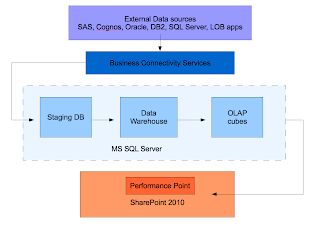
What it is, is a portal with enhanced dashboarding and other elements that provide the "presentation layer" for your BI 'system'. I have attempted to reproduce an architecture slide we were shown, which shows that to pull data in from other sources you need to do an Extract Transform and Load (ETL) operation, so that OLAP cubes can be built using SQL Server's Reporting Services, and this in turn can feed the data to the SharePoint components for rendering and display:
Visio Services adds an interesting element to the mix - it is basically Microsofts's 'mashup' engine - producing interactive graphics using Silverlight, which allow you to graphically interact with data. For example if you have those lovely Visio diagrams of your data centre (or server room) that infrastructure people normally delight in creating - you can use this as graphical element and combine it with data from your monitoring systems so that if a server goes offline, then it goes red and flashes in the picture ! OK, not a very BI centric example, but you get the idea.
Excel and Access Services are there to help provide some centralised management of the data created, stored and manipulated in these tools. I have always thought that Access 'End User Computing' was a bit of nightmare, non-developers using a desktop tool to 'develop' what often turn into business critical LOB apps. Excel can be the same, I have seen businesses where the financial 'system' is 20 highly complex interlinked Excel files... !! So Excel and Access services allow you to draw things back towards the centralised management that allows you be sure what is the 'single source of truth' by publishing the information via SharePoint.
- Performance Point Services
- Access Services
- Excel Services
- Visio Services
- Business Connectivity Services
Well no, not at all actually. SP2010 brings enhanced portal features and enhanced connectivity to other data sources (structured and non-structured) but SharePoint itself, not even with Performance Point Services, is not a business intelligence system, like Cognos for example.
What it is, is a portal with enhanced dashboarding and other elements that provide the "presentation layer" for your BI 'system'. I have attempted to reproduce an architecture slide we were shown, which shows that to pull data in from other sources you need to do an Extract Transform and Load (ETL) operation, so that OLAP cubes can be built using SQL Server's Reporting Services, and this in turn can feed the data to the SharePoint components for rendering and display:

Click on the diagram to see a full sized version
BI for the masses then ? Maybe, but possibly more because of the ability of business power users to use SharePoint designer without recourse to professional developers in order to build their dashboard sites, but that is definitely power user - not 'normal' user. That being said, it does appear easier to do things than my 'back in the day' SAS experience (which is what you would hope after 6 years !) and if you have any experience at all with building 'web part' pages in MOSS2007, you will feel at home.Visio Services adds an interesting element to the mix - it is basically Microsofts's 'mashup' engine - producing interactive graphics using Silverlight, which allow you to graphically interact with data. For example if you have those lovely Visio diagrams of your data centre (or server room) that infrastructure people normally delight in creating - you can use this as graphical element and combine it with data from your monitoring systems so that if a server goes offline, then it goes red and flashes in the picture ! OK, not a very BI centric example, but you get the idea.
Excel and Access Services are there to help provide some centralised management of the data created, stored and manipulated in these tools. I have always thought that Access 'End User Computing' was a bit of nightmare, non-developers using a desktop tool to 'develop' what often turn into business critical LOB apps. Excel can be the same, I have seen businesses where the financial 'system' is 20 highly complex interlinked Excel files... !! So Excel and Access services allow you to draw things back towards the centralised management that allows you be sure what is the 'single source of truth' by publishing the information via SharePoint.
So is SP2010 really "BI for the masses" - no way ! No more than MOSS2007 was really "ECM for the masses" - these are just horrible marketing phrases. However will SP2010 with enterprise CAL's and the attendant SQL Server 2008 licenses be able to provide "timely access to business intelligence data" - absolutely ! And it will provide the tools and capabilities to allow you to slice and dice as you require, and to mash it up and present it in easily digestible formats.
Add to that the capability to use the 'Insights' elements with the collaboration tools such as blogs and wiki's and other social computing elements (user tagging and rating) to explain values, trends, the benchmarks your using etc, etc, then SP2010 definately provides the basis for building highly interactive and very usable 'decision support systems'.
A big thanks to Peter Carson, President of EnvisionIT, Joe Seguin Senior Consultant at EnvisionIT and Eric Moll of Microsoft for an excellent briefing.


